| Tarisio | https://tarisio.com/cozio-archive/browse-the-archive/makers/maker/?Maker_ID=157 |
| Brompton’s | https://www.bromptons.co/reference/makers/details/degani-giulio.html |
ジュリオ・デガーニ(1875-1959)
Eugenioの息子
Violin maker
(maker: 1875 – 1959)
Giulio Degani was the son of Eugenio, with whom he worked from an early age. After his father’s death in 1901 he remained in the family’s Venice workshop until emigrating to the USA in 1915. Here he worked for the Wurlitzer firm in New York and later Cincinnati. Labels marked Venice from this period suggest that he might have divided his time between Italy and the US for a while.
In 1924 Degani opened his first shop, moving to Atlantic City in 1933, then returning to Cincinnati in 1937. Business appears to have been hard, and in 1938 Simone Sacconi told Dario D’Attili that Degani couldn’t sell his violins for $50. He finally closed his shop in 1952. The following year he wrote in a letter to a friend that he was working in a mirror factory.
Degani’s early work closely follows that of his father, while later instruments show a more personal approach, including flatter edges, shorter corners and a bolder style of scroll.
ジュリオDegani
バイオリンメーカー
(メーカー:1875から1959)
ジュリオ・デガーニは、エウジェニオの息子で、幼い頃から一緒に仕事をしていました。1901 年に父親が亡くなった後、彼は 1915 年にアメリカに移住するまで一家のベニスの工房に留まりました。ここで彼はニューヨークの Wurlitzer 社と後にシンシナティで働きました。この時期のベニスに記されたラベルは、彼がしばらくイタリアとアメリカの間を行き来していたことを示唆しています。
1924 年に Degani は、彼の最初のショップを開き、1933 年に Atlantic City に移動し、1937 年に Cincinnati に戻りました。商売は大変だったようで、1938年にはSimone SacconiがDario D’Attiliに、Deganiは自分のヴァイオリンを50ドルでは売れなかったと語っている。彼は1952年についに店を閉めた。翌年、彼は友人に宛てた手紙の中で、鏡工場で働いていることを記している。
デガーニの初期の作品は父の作品を忠実に再現しているが、それ以降の楽器は、より平坦なエッジ、短いコーナー、大胆なスクロールのスタイルなど、より個性的なアプローチが見られる。
www.DeepL.com/Translator(無料版)で翻訳しました。
ジュリオ ・ エット レ ・ デガーニ
Giulio Ettore DEGANI
(1875年9月15日モンタニャナ生 – 1955年シンシナッティ没)
略歴
1894年頃~1898年頃ヴェネツィア(Venezia)でオイゲーニオ ・ デガー ニに師事
1898年~1901年ヴェネツィア(Venezia)でオイゲーニオ ・ デガーニと一緒に活動する
1901年~1922年ヴェ ネツィア(Venezia)で活動する
1922?年~1932?年シンシナッティ(Cincinnati)で活動する
弟子・職人
Simone Fernando SACCONI (シィモネ ・ フルナンド ・ サッコーニ (職人))1912年~1921年 [TW]
Liuteria Italiana(Eric Blot) Vol.2 Pag.277
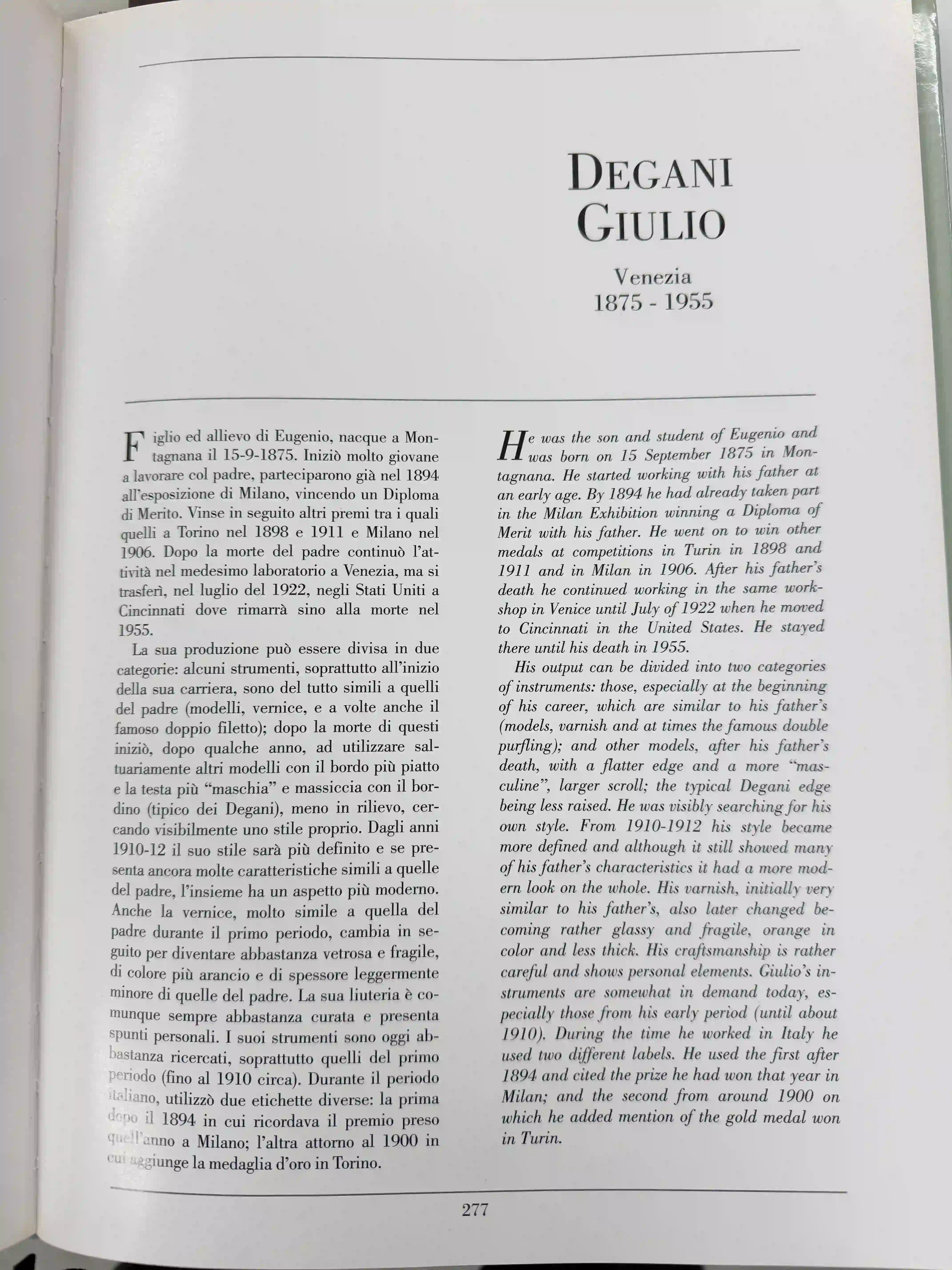
He was the son and student of Eugenio andwas born on 15 September 1875 in Mon-tagnana. He started working with his father at an early age. By 1894 he had already taken part in the Milan Exhibition winning a Diploma of
Merit with his father. He went on to win other medals at competitions in Turin in 1898 and 1911 and in Milan in 1906. After his father’s death he continued working in the same workshop in Venice until July of 1922 when he moved to Cincinnati in the United States. He stayed there until his death in 1955.
His output can be divided into two categories of instruments: those, especially at the beginning of his career, which are similar to his father’s (models, varnish and at times the famous double purfling); and other models, after his father’s death, with a flatter edge and a more “mas-culine”, larger scroll; the typical Degani edge being less raised. He was visibly searching for his own style. From 1910-1912 his style became more defined and although it still showed many of his father’s characteristics it had a more mod-ern look on the whole. His varnish, initially very similar to his father’s, also later changed be-coming rather glassy and fragile, orange in color and less thick. His craftsmanship is rather careful and shows personal elements. Giulio’s in-
struments are somewhat in demand today, especially those from his early period (until about 1910). During the time he worked in Italy he used two different labels. He used the first after 1894 and cited the prize he had won that year in Milan; and the second from around 1900 on which he added mention of the gold medal won in Turin.
彼はエウジェニオの息子であり弟子で、1875年9月15日にモンタニャーナで生まれた。幼い頃から父と共に仕事を始め、1894年にはすでにミラノ博覧会に父とともに出品し、功労賞を受賞している。その後も、1898年と1911年のトリノ、1906年のミラノのコンクールでメダルを獲得した。父の死後もヴェネツィアの同じ工房で制作を続けたが、1922年7月にアメリカ合衆国のシンシナティへ移住し、1955年に亡くなるまでそこに滞在した。
彼の作品は大きく二つのタイプに分けられる。
- 1)キャリア初期の、父の作品に似たもの(モデル、ニス、時に有名なダブルパーフリングなど)。
- 父の死後に作られた、縁がより平らで、より「男性的」で大きなスクロールを持つモデル。典型的なデガーニ家の縁の盛り上がりは控えめになり、彼自身のスタイルを模索していたことが見て取れる。
1910〜1912年頃にはスタイルがより確立し、父の特徴を多く残しながらも全体としてよりモダンな外観になった。ニスも当初は父と似ていたが、後にはガラス質で壊れやすく、オレンジ色で厚みの少ないものへと変化した。彼の作風は丁寧で、個性的な要素も見られる。ジュリオの楽器は現在でも一定の需要があり、特に1910年頃までの初期作品が人気である。
イタリアで制作していた時期には2種類のラベルを使用した。
最初のラベルは1894年以降に使われ、その年のミラノでの受賞歴が記されている。
1900年頃からは、トリノでの金メダル受賞を追記した第二のラベルを使用した。
Great Italian Violinmaking(Artemio Versari) Pag.154